Showing posts with label Truth. Show all posts

Wednesday, November 11, 2009

My book launch in New York


My book launch in New York on 11 November 2009 went really well in New York. A "conversation" about the book with about 50 people. Also inputs from Graeme Simpson, Ruti Teitel, Alastair Ager. Chaired and organised by Jack Saul (thanks Jack). Great to also see some CSVR people.

Wednesday, July 15, 2009

Transforming Societies after Political Violence

My book Transforming Societies After Political Violence: Truth, Reconciliation and Mental Health, now published by Springer in New York.

Transforming Societies after Political Violence offers a template for those tasked with providing truth, justice, reconciliation, and healing. This interdisciplinary study identifies complex relationships between recovery from political violence and the psychological processes that accompany widespread social change, showing how these can be integrated to strengthen both individual and society. Author Brandon Hamber draws on his extensive experience in South Africa and comparative examples from elsewhere to examine the centrality of mental health issues in transitional justice, and the social, cultural, and identity issues involved in meeting the needs of victims. In discussing reparations (what the author terms "repairing the irreparable"), the power of ambivalence, and especially concepts of closure, he eloquently sets out professionals’ roles in helping survivors move beyond the toxic past without covering it up or becoming mired in it. ISBN: 978-0-387-89426-3, Springer 2009

Available

Springer (Publisher)
Springer Online
Amazon (UK)
Amazon (US)

Endorsements
How to victims heal? We should not be too quick to presume. Those seeking truth and justice often prioritize victims’ interests – but without always fully understanding what those interests and needs are, or how different victims may recover in very different ways. Based on fifteen years of working with and listening to victims and survivors, Brandon Hamber helps us better understand the mental health backdrop to atrocity and recovery. With plentiful, poignant stories, and clear policy recommendations, this book should help shape – and greatly improve – future endeavors to confront unimaginable memories and pain (Priscilla Hayner, International Centre for Transitional Justice and author of Unspeakable Truths: confronting state terror and atrocity)

Brandon Hamber nails this tricky subject with humility, insight, learned insight, and golden recommendations..... if you are interested in how humans try to grapple with the consequences of man’s brutality to man, and ultimately the truth, read it! (Thulani Grenville-Grey, former South African Truth and Reconciliation Commission Mental Health Specialist)

Brandon Hamber's experience in multiple sites of transitional justice work, and his rare ability to bridge the academic and theoretical with the practical and logistical, ensures this publication is an extremely valuable contribution and a must read to those working in this fast evolving field (Piers Pigou, former South African Truth and Reconciliation Commission Investigator and Director of the South African History Archive).

Brandon Hamber has written a challenging and good interdisciplinary book, which will not only be helpful to those dealing with mental health issues during transitions from conflict, but also to lawyers and those concerned with conflict resolution more generally (Christine Bell, Director, Institute of Transitonal Justice, University of Ulster)

How countries recover from political atrocity is a question that has confronted dozens of regimes around the world for decades. The South African Truth and Reconciliation Commission is an iconic symbol of what for some is a profound achievement in restructuring a “peaceful society.” In Transforming Societies After Political Violence: Truth, Reconciliation, and Mental Health Dr. Brandon Hamber applies his many years of experience both within the Truth and Reconciliation Commission and beyond it to a careful analysis of the complex issues – legal, historical, social, psychological - embedded in such a process. It is his astute attention to these complexities that make his book so rich. Hamber says that “if the TRC process and working with the victims appearing before it taught me anything it was that the psychological life of the survivor of extreme violence is cut through by this complexity." His work is clear testimony to that statement Transforming Societies After Political Violence is a valuable resource for researchers, practitioners, scholars and policy makers. If you read one book about countries emerging from their violent pasts, it should be Dr. Brandon Hamber’s Transforming Societies After Political Violence. I will rely on this volume in my ongoing work and I predict it will become a definitive text in this area (Nina K. Thomas, Ph.D., ABPP, Chair, Specialization in Trauma and Disaster Studies; NYU Postdoctoral program in Psychotherapy and Psychoanalysis; Co-Chair, Relational Orientation; NYU Postdoctoral Program in Psychotherapy and Psychoanalysis; Adjunct Clinical Associate Professor NYU Postdoctoral Program in Psychotherapy and Psychoanalysis)

Hamber brings an acute clinical sensibility and sophisticated research mind to a complex problem: state handling of reconciliation after a catastrophic upheaval. … his main focus in this book is the South African Truth and Reconciliation Commission (TRC) process. … a must read for any psychologist working with trauma survivors, especially postconflict trauma survivors. It calls upon a rich literature–from psychoanalysis … to trial transcripts of commissions; it integrates all these sources to provide a truly unique contribution to the psychology of trauma." (Don Dutton, PsycCRITIQUES, Vol. 54 (47/3), November, 2009)

Friday, February 1, 2008

Truth a stranger, fiction the norm

For South Africans, what happens in Northern Ireland probably seems tangential to everyday life. However, living in Belfast means that I cannot escape it. Currently, as the new power-sharing government beds down, the issue of dealing with the past is taking up much media space. This marks a major shift. A few years ago, the question was off limits.

That said, exactly how society should deal with its past remains unclear. Some still favour ‘drawing a line’ under it. There is much talk of the South African approach, but few takers.

Last year, the British government set up a Consultative Panel on the Past to provide a way forward. The fact that it was a panel appointed by the British government, which is a player in the conflict, means that some people question whether it is the best vehicle to chart a way forward. Nonetheless, work has begun, with most adopting a ‘wait and see’ attitude.

Recently, the panel burst into public view with controversies about whether amnesty should be granted and whether the conflicts of the past should be labelled a ‘war’ or not. To South Africans, this might sound strange. Although this is an odd place for the discussion to start, it belies wider questions familiar to South Africans. In terms of amnesty, what compromises will be needed to deal with the past? As regards the ‘war’ question, this is significant in terms of acknowledging the extent of the conflict, and determining whose actions were legitimate.

South Africa was forced to confront these questions, given the scale of deaths, but in Northern Ireland, where 3 600 people lost their lives, it seems as if people think confronting the past is a choice. That said, the population is only 1,5-million, so 3 600 deaths is proportionally close to the number (roughly 25 000) of those who died in South Africa from political violence.

It seems, however, as if Northern Ireland has not reached first base. One critical question needs to be answered at this stage: is truth about past violations a right? Do we think knowing about the past from all sides is important, in principle? If so, then the next step is not to list all the reasons why this will never be possible, but rather to ask how society can ensure truth can be delivered. This needs political and social backing, independence and integrity.

South Africa, at least at political level, opted for the idea of truth as non-negotiable. This resulted in the truth commission. However, as I write, I am struck by the fact that much business related to the past is still not finished in South Africa. For example, those who failed to take the opportunity to apply for amnesty during the life of the Truth and Reconciliation Commission have not been prosecuted for crimes such as murder and torture, or told the truth. For most victims, truth and justice remain elusive. Most continue to live in poverty.

So, as Northern Ireland confronts the question whether it should engage in truth recovery for the first time, perhaps, South Africans have to ask the question for a second time. Some of you reading this will roll your eyes at such a suggestion, but, if we think truth is a principle our young democracy should embody, have we done enough about uncovering and addressing the horrors of the past?

In turn, is the lack of a principled and unrelenting quest for the truth about the past emblematic of how we pursue truth in the present? It seems that when we suspect a cover-up, we establish a commission with much fanfare and promises of truth recovery and justice, but over time such endeavours lose focus and grind to a halt. Remember, to paraphrase writer HL Mencken, truth would cease to be stranger than fiction, if we were as used to it as to lies.

This article by Brandon Hamber was published on Polity and in the Engineering News on 1 February 2008 as part of the column "Look South". Copyright Brandon Hamber.

Sunday, April 18, 2004

Overcoming Apartheid: Can Truth Reconcile a Divided Nation?

Overcoming Apartheid: Can Truth Reconcile a Divided Nation? This is the second entry in Gibson’s “Overcoming Trilogy” (the first was Overcoming Intolerance in South Africa: Experiments in Democratic Persuasion, Cambridge University Press). Russell Sage describes the book as follows: Overcoming Apartheid reports on the largest and most comprehensive study of post-apartheid attitudes in South Africa to date, involving a representative sample of all major racial, ethnic, and linguistic groups. Grounding his analysis of “truth” in theories of collective memory, Gibson discovers that the process has been most successful in creating a common understanding of the nature of apartheid, more...

Friday, August 22, 1997

Truth: The road to reconciliation?

At the public hearings of the Truth and Reconciliation Commission (TRC) hangs a banner, "Truth the Road to Reconciliation". These words encapsulate one of the principal paths South Africans have taken to deal with their dark past. To this end, the TRC has the express purpose of facilitating a truth recovery process through public hearings and statement-taking. Since its inception in December 1995, the TRC has aimed to give voice to the experiences of victims, witnesses and perpetrators, intent on uncovering as complete a picture as possible of the causes, nature and extent of past abuses. Thereafter, the TRC aims to make amends to victims through the granting of reparations and rehabilitative measures.

As part of its reconciliatory function, the TRC is also responsible for the granting of amnesty, which means that perpetrators of gross violations of human rights who meet TRC criteria are free from prosecution and all liability then falls away. To receive amnesty, perpetrators must have committed politically-motivated crimes and fully disclosed all the information concerning their actions. At the end of its term of office in March 1998, the TRC will document all of its findings in a comprehensive report, making recommendations aimed at preventing such large-scale abuse from ever occurring again.

To date, the TRC has taken some 10,000 statements from survivors or families of victims of murder, attempted murder, "disappearance" and torture. A number of representative cases have been selected for public hearings based on these statements. Sixty-five such hearings, at which victims have told their stories to the nation, have been held thus far. The TRC has also received a staggering 5,400 amnesty applications. Although time is running out, only 50 findings have been made, of which roughly 70 percent have resulted in situations where perpetrators of gross violations of human rights have been granted amnesty.

In evaluating the process, it is clear that providing space for victims to tell their stories has been of much use. It is the first time that many South Africans have been able to do so to a sympathetic ear. Furthermore, their cases have been referred to the 60-odd national investigators of the TRC Investigation Unit for thorough investigation. In the past, often due to police complicity, most people were turned away from police stations, particularly when their cases were of a political nature.

Despite the success of the hearings, the actual psychological impact of giving public voice to trauma has had varying consequences for victims. For some, it has been the final leg of a personal healing journey while for others, it has only been the first step. Throughout the TRC process, there has often been a simplistic assumption that catharsis through telling one's story is sufficient for emotional healing. This is only partially true. For many, although public acknowledgement of their suffering may have restored their dignity and taken away feelings of guilt, psychological healing remains far off and of a highly personalised matter. Such healing usually requires ongoing support from professionals, community groups, relatives and other support structures like religious bodies. The individual follow-up of victims by the TRC has not been as extensive as was hoped. Undoubtedly, the emotional needs of many victims remain insufficiently addressed.
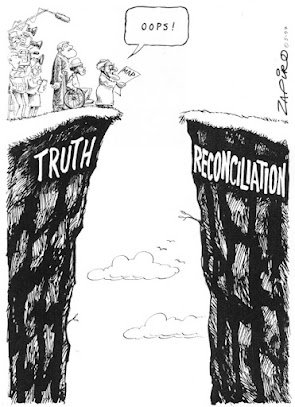
© 1997 - 2022 Zapiro (All Rights Reserved). 
Originally published in The Sowetan in 1997. 
Printed/Used with permission. 
More Zapiro cartoons at www.zapiro.com


Regarding reparations or compensation for victims, the TRC is only responsible for drawing up policy as reparations will be steered by the government following the TRC-mandated period. The hearings have revealed that the needs of survivors and families of victims are varied. Some people simply want a tombstone to commemorate the death of a loved one, others want financial assistance due to the loss of a bread winner, while some demand that the perpetrator be punished. On a psychological level, reparations can serve for survivors as a symbol representing that they have come to terms with a trauma. On a purely practical level though, the sheer number of victims needing reparation makes the idea of individualised reparation difficult to imagine. Nonetheless, the government remains obligated to offer victims some form of compensation for their suffering because the granting of amnesty to perpetrators has denied victims the possibility of a civil claim.

In addition to possibly offering individualised reparation, the TRC will also make recommendations about symbolic ways of remembering the past. A memorial dedicated to those who lost their lives fighting against apartheid, perhaps similar to the Vietnam War Memorial, is certainly a possibility.

The amnesty granting function of the TRC remains most controversial. Political analysts argue that amnesty is necessary to ensure a peaceful resolution in South Africa and that large-scale prosecutions are simply not possible given the inefficiencies of the criminal justice system. For survivors and families of victims, it remains difficult to see perpetrators walk free yet the South African model is a significant improvement to that of other countries, though, as amnesty is not automatic or blanket. Perpetrators have to qualify for amnesty, specifically needing to make a full, public confession. This means that for many people, the truth about the past will finally be known.

However, despite the value of knowing the truth as implied by the TRC slogan, truth alone does not always lead to reconciliation. Some victims may be satisfied by knowing the facts, particularly in the case of a "disappearance" but for others, truth may heighten anger and calls for justice rather than leading to feelings of reconciliation. There is also the constant threat of a perpetuated cycle of revenge once the truth is out. Thus, survivors and families of victims need to accept their anger as legitimate without feeling they are expected to forgive perpetrators. Community-based groups provide some victim support as outlets for frustrations. In contrast, the TRC has at times failed to provide adequate space for victims to vent their anger.

Even if the compromise of amnesty had to be made for pragmatic reasons, the TRC has failed to make it explicit that the Commission is of the opinion that it was an "evil" compromise. This may have devastating effects. It can leave victims feeling that the TRC favours perpetrators over themselves. This perception is further heightened by the sense that at present it appears as though perpetrators have more to gain by receiving amnesty than victims have through reparation. Reparation seems distant as it will only occur once the TRC is over and their is no guarantee of what form it will take. A further problem is that no matter what form of reparation is offered, it can never bring back a loved one. Coming to terms with the past psychologically can only in part be addressed by a reparations policy.

The road to reconciliation in South Africa remains a thorny one. Undoubtedly, the TRC has helped smooth the path. The value of publicly revisiting the sad and brutal days of apartheid has opened the eyes of many, having partially developed a collective history for South Africans and allowed victims to evolve a new meaning for their suffering. However, individual processes of forgiveness and reconciliation may not always intersect with the collective process offered by the TRC at this time.

It is a mistake to assume that storytelling equates with healing and that truth alone will lead to reconciliation. Truth does not ensure transformation. Much work remains to be done to actively engage with the offending institutions like the security forces to secure lasting change. Simply knowing the truth is no guarantee that a human rights culture will permeate their future operations. Perhaps most basically, the new government has the difficulty of delivering real economic change because all the truth in the world will never address the multiple effects and miseries created by ongoing poverty.

This article was published in Cantilevers: Building Bridges for Peace, Vol. 3, 1997. At the time, Brandon Hamber was the Manager of the Transition and Reconciliation Unit at the Centre for the Study of Violence and Reconciliation.