My article "Dealing with Painful Memories and Violent Pasts. Towards a Framework for Contextual Understanding" has now been published in the Berghof Handbook Dialogue Series No.11.
The article reflects on the role of different approaches for dealing with painful memories and violent pasts. In it I explore how different dimensions – interpersonal and intergroup relations, memories and identities at the individual and collective level – relate to one another. I also address how one can constructively address victim identities and cultures of victimhood that may stem from painful or traumatic experiences in light of my work in South Africa and Northern Ireland, among other locales.
You can download the paper by clicking here.
Tuesday, April 28, 2015
Friday, January 23, 2015
Together: Building a United Community Strategy
In May 2013 the Northern Ireland Executive published 'Together: Building a United Community' Strategy which it stated signalled the "Executive’s commitment to improving community relations and continuing the journey towards a more united and shared society".
In autumn 2014, The Committee for the Office of the First Minister and deputy First Minister (OFMdFM) launched an Inquiry into the Building a United Community Strategy (TBUC) and called for submissions. Some 70 organisations responded to the call.
On 21 January 2014 I was asked to give evidence to the Committee about the Strategy. Here are my opening comments to the Committee.
Key Documents
Input by Professor Brandon Hamber to the Committee of OFMdFM
Terms of Reference of the Committee
'Together: Building a United Community' Strategy
Responses to the Consultation
OFMdFM Updates on Together: Building a United Community
In autumn 2014, The Committee for the Office of the First Minister and deputy First Minister (OFMdFM) launched an Inquiry into the Building a United Community Strategy (TBUC) and called for submissions. Some 70 organisations responded to the call.
On 21 January 2014 I was asked to give evidence to the Committee about the Strategy. Here are my opening comments to the Committee.
Key Documents
Terms of Reference of the Committee
'Together: Building a United Community' Strategy
Responses to the Consultation
OFMdFM Updates on Together: Building a United Community
Wednesday, December 24, 2014
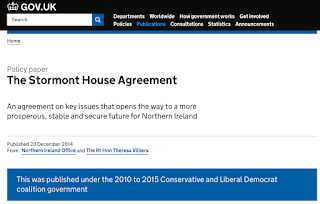
Stormont House Agreement
After 11 weeks of talks at Stormont, this agreement was reached with Northern Ireland’s political leaders, providing a new approach to some of the most difficult issues left over from Northern Ireland’s past. It offers a new start and a far more hopeful future, but will need continued hard work to ensure it fulfils its promise.
Monday, December 1, 2014
Psychosocial, Peacebuilding and Social Change
Hamber, Brandon, Gallagher, Elizabeth and Ventevogel, Peter (2014) Narrowing the gap between psychosocial practice, peacebuilding and wider social change: an introduction to the Special Section in this issue. Intervention: Journal of Mental Health and Psychosocial Support in Conflict Affected Area, 12 (1), 7-15 [Download]
Tuesday, November 25, 2014
Reconciliation
Duncan Morrow in the US Institute of Peace Insight Newsletter (Fall 2014) noted “Reconciliation,” according to the Concise Oxford Dictionary, means “to make friendly again after an estrangement” and “to make acquiescent or contentedly submissive to something previously disagreeable”….. Classical peacemaking focuses on the first definition, with its emphasis on mutual friendship and the making of new relationships on all sides. Politics … has often seen reconciliation in the second sense, as something the loser in a conflict must do to come to terms with reality.”
There is a view, as outlined by Morrow above, that reconciliation aims at rebuilding fractured relationships after a conflict. This objective is pursued through dialogue, sharing stories, mediation, or other peacebuilding activities that convene individuals, groups, or communities. The purpose of such activity is to foster those deep and lasting connections across the society considered essential to sustainable peace.
It is challenging to think of political entities engaging in such work, as the Morrow quotation indirectly implies. In politics, claims Morrow, reconciliation has a harder edge and reconciliation is more about the loser becoming “contentedly submissive” with the victor after a conflict ends.
Relationships at all levels matter following political conflict, as they determine whether and how the progress to peace and stability will be made. In a divided society, building a new road is never simply a technical task—it invariably requires negotiation and discussion about the benefits for each actor. Inevitably, harms due to past violence, even in the most mundane of policy decisions, will surface during that process.
Reconciliation is not about a simple decision to cooperate, or designing processes so former adversaries can work together with the long-term aspiration that deeper connections will follow. This could result in a forgive-and-forget mentality or, if Morrow is right, an approach akin to getting on with “negative peace” in a resigned manner. This approach is not conducive to long-term stability or what I understand reconciliation to be.
In the short-term, coexistence and cooperation might be all that is possible. However, if lasting peace is to be guaranteed, we cannot avoid addressing relationships in a deliberate and strategic way. Justice, apology, reparations, acknowledgement, and healing are part of this process— issues that are not separate from reconciliation but central to it.
Published by Brandon Hamber in US Institute of Peace Insight Newsletter (Fall 2014), click the link to also see alerie Rosoux's Response to my comments and other articles on reconciliation in the edition.
There is a view, as outlined by Morrow above, that reconciliation aims at rebuilding fractured relationships after a conflict. This objective is pursued through dialogue, sharing stories, mediation, or other peacebuilding activities that convene individuals, groups, or communities. The purpose of such activity is to foster those deep and lasting connections across the society considered essential to sustainable peace.
It is challenging to think of political entities engaging in such work, as the Morrow quotation indirectly implies. In politics, claims Morrow, reconciliation has a harder edge and reconciliation is more about the loser becoming “contentedly submissive” with the victor after a conflict ends.
Relationships at all levels matter following political conflict, as they determine whether and how the progress to peace and stability will be made. In a divided society, building a new road is never simply a technical task—it invariably requires negotiation and discussion about the benefits for each actor. Inevitably, harms due to past violence, even in the most mundane of policy decisions, will surface during that process.
Reconciliation is not about a simple decision to cooperate, or designing processes so former adversaries can work together with the long-term aspiration that deeper connections will follow. This could result in a forgive-and-forget mentality or, if Morrow is right, an approach akin to getting on with “negative peace” in a resigned manner. This approach is not conducive to long-term stability or what I understand reconciliation to be.
In the short-term, coexistence and cooperation might be all that is possible. However, if lasting peace is to be guaranteed, we cannot avoid addressing relationships in a deliberate and strategic way. Justice, apology, reparations, acknowledgement, and healing are part of this process— issues that are not separate from reconciliation but central to it.
Published by Brandon Hamber in US Institute of Peace Insight Newsletter (Fall 2014), click the link to also see alerie Rosoux's Response to my comments and other articles on reconciliation in the edition.
Friday, October 24, 2014
Healing and Change in the City of Gold
I am delighted to announce that my new book, edited with Ingrid Palmary and Lorena Nunez is now out. It is entitled Healing and Change in the City of Gold: Case Studies of Coping and Support in Johannesburg.
This book offers radically new ways of thinking about precarious life in the city of Johannesburg. Using case studies as varied as Pentecostal and Zionist churches, brothels, shelters, political movements for change in Zimbabwe, ex-soldiers groups, counseling services and art projects, this volume grapples with the way its predominantly migrant residents navigate the opportunities, challenges, moral orders and relationships in this iconic and complex city.
Taking seriously how context shapes meaning the authors use participatory and ethnographic techniques to understand people’s everyday responses to the violence, insecurity and possibilities for change that they face in contemporary Johannesburg. Read together, the case studies give us new insights into what it means to seek support, to cope and to heal, going beyond what mental health professionals traditionally consider support mechanisms or interventions for those in distress. They develop a notion of healing that sees it as a process and an outcome that is rooted in the world-view of those who live in the city.
Throughout the chapters in this book is a sense of everyday insecurity alongside an equally strong sense of optimism, care and a striving for change. It is perhaps not surprising, then, that this book deals very centrally with themes of the struggle for progress, mobility (geographic, material and spiritual), and the sense of possibility and change associated with the City of Gold. Ultimately, the volume demonstrates that coping and healing are both a collective and individual achievement, as well as a economic, psychological, spiritual and material phenomenon shaped by context.
Interested in a copy, you can buy from Amazon, or directly from Springer.
You can also get updates on the book by visiting the Facebook Page.
This book offers radically new ways of thinking about precarious life in the city of Johannesburg. Using case studies as varied as Pentecostal and Zionist churches, brothels, shelters, political movements for change in Zimbabwe, ex-soldiers groups, counseling services and art projects, this volume grapples with the way its predominantly migrant residents navigate the opportunities, challenges, moral orders and relationships in this iconic and complex city.
Taking seriously how context shapes meaning the authors use participatory and ethnographic techniques to understand people’s everyday responses to the violence, insecurity and possibilities for change that they face in contemporary Johannesburg. Read together, the case studies give us new insights into what it means to seek support, to cope and to heal, going beyond what mental health professionals traditionally consider support mechanisms or interventions for those in distress. They develop a notion of healing that sees it as a process and an outcome that is rooted in the world-view of those who live in the city.
Throughout the chapters in this book is a sense of everyday insecurity alongside an equally strong sense of optimism, care and a striving for change. It is perhaps not surprising, then, that this book deals very centrally with themes of the struggle for progress, mobility (geographic, material and spiritual), and the sense of possibility and change associated with the City of Gold. Ultimately, the volume demonstrates that coping and healing are both a collective and individual achievement, as well as a economic, psychological, spiritual and material phenomenon shaped by context.
Interested in a copy, you can buy from Amazon, or directly from Springer.
You can also get updates on the book by visiting the Facebook Page.
Subscribe to:
Posts (Atom)