South Africa has a new leader; the current negotiators in the North feel like a spent force
In a strange way the South Africa and Northern Ireland peace processes have always been linked. In the 1990s both were heralded as examples of how deep divisions could be overcome, and co-operation fostered between former enemies. Other connections were more direct, such as the former ANC lead negotiator and now new South African president Cyril Ramaphosa’s role in the decommissioning processes as an inspector on behalf of the Independent International Commission on Decommissioning.
Two decades later, however, both peace processes have lost their shine.
In Northern Ireland a lot has been achieved. For example, a stable powersharing arrangement was running for a number of years, there has been substantial police reform and a dramatic decrease in political deaths.
However, the powersharing government has been collapsed for over a year. Social division also remains. Some 90 per cent of social housing is still single-identity, according to the Northern Ireland Federation of Housing Associations. Only 7 per cent of children go to integrated schools.
Although paramilitary activity has decreased, there were 30 bombing incidents last year. Assaults, mainly on young males, by paramilitary groups have continued at roughly consistent rates for the last 10 years.
Significant gains
For South Africa, redressing decades of racial inequality has been a priority. Significant gains have been made. For example, 93 per cent of South Africans now have access to potable water compared to 62 per cent in 1994. The ANC government has built three million homes, housing 16 million people.
However, a backlog of 2.5 million houses remains. The official unemployment rate stands at a staggering 26 per cent. On top of this, the former government led by Jacob Zuma was throughout beset with serious corruption allegations.
However, unlike Northern Ireland, which has now seen a breakdown in the negotiations to re-establish powersharing, South Africa saw Ramaphosa instated as president. A wave of new-found optimism has swept the country. In his state-of-the nation address on Friday, Ramaphosa spoke of a new dawn, turning the tide against corruption and tackling inequalities, while maintaining economic stability.
The campaign to remove Zuma has been sustained over a number of years, and has included media exposés of corruption, large public demonstrations by opposition parties and civil society organisations, a series of court cases that have opened the way for the prosecution of Zuma and his cronies, and latterly a determined bloc inside the ANC and its allies to remove Zuma from office.
South Africans have a new belief in democracy and people power, and have learned first-hand the value of a free media and an independent judiciary. There is new hope in the constitution, the rule of law and the institutions developed to protect democracy.
Frustration
In Northern Ireland things feel very different. Everywhere one turns you hear people complaining about the inability of politicians to make a deal. The frustration is palpable, yet the malaise continues despite the ongoing division, Brexit and economic difficulties looming large.
Like Zuma’s administration that suffered from illegitimacy and drift, the Stormont talks have lost their way, and have lost touch with the people.
While South Africans are optimistic on the promises of Ramaphosa’s “new dawn”, Northern Ireland wallows in the tatters of what was once called a “fresh start”. So why the difference, and what can be done?
First, in South Africa there has at last been a qualitative change in leadership. In contrast, the current negotiators in the North feel like a spent force. Although some top positions in Northern Ireland have changed, those who were there at the start of the current impasse remain largely the same. One way to change this dynamic is to rework the talks structure to include all political parties, bringing in new leadership.
Second, civil society participation has been key to the new South African impetus. It is time to reignite civil society interest in the Northern Ireland peace process. New ways of people interacting with the talks have to be found. Ideas such as a citizens’ assembly have been proposed. Politicians need to encourage new civic interactions rather than corralling around the stale and secret Stormont talks.
New energy
Of course, South Africa is not a perfect or a directly comparable model. The new energy will dwindle over time if expectations are not met. Time will tell if Ramaphosa can deliver. But the current situation in South Africa reminds us once again that change is possible and the re-set button can be pushed. Hope and vitality can be restored to the body politic.
We forget at our peril that a commitment to a new vision, farsighted leadership, civil society engagement and, ultimately, the willingness to compromise is what drove the remarkable changes in Northern Ireland and South Africa in the 1990s.
Unless this genuine spirit for transformation can be reignited in Northern Ireland, as it has been sparked in South Africa recently, the risk is that the Belfast Agreement will become a rather sullied footnote in history.
Published by Professor Brandon Hamber, John Hume and Thomas P O’Neill chair in peace based at the International Conflict Research Institute (INCORE), Ulster University, Irish Times, 20 February 2018
The original article is available here in the Irish Times, 20 February 2019
Showing posts with label Stormont Talks. Show all posts
Tuesday, February 20, 2018
Wednesday, December 24, 2014
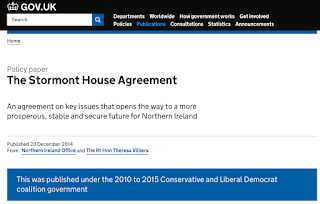
Stormont House Agreement
After 11 weeks of talks at Stormont, this agreement was reached with Northern Ireland’s political leaders, providing a new approach to some of the most difficult issues left over from Northern Ireland’s past. It offers a new start and a far more hopeful future, but will need continued hard work to ensure it fulfils its promise.
Tuesday, December 1, 1998
Past Imperfect: Dealing with the Past in Northern Ireland and Societies in Transition
Past Imperfect: Dealing with the Past in Northern Ireland and Societies in Transition, edited by Brandon Hamber is now available free online.
Past Imperfect was published in 1998 by INCORE/UU: Derry/Londonderry, Northern Ireland. ISBN 0 9533305-4-0.
This publication brings together the papers presented at the 'Dealing with the Past: Reconciliation Processes and Peace Building' Conference and draws on the ideas of the participants to further the debate about dealing with, or perhaps not dealing with, the past in Northern Ireland. Includes chapters on South Africa, Northern Ireland and Guatamala.
Download the Book (Zipped File)
Contributors
Sir Kenneth Bloomfield was educated at the Royal Belfast Academical Institution (of which he is a governor) and St Peter's College, Oxford, where he read Modern History. He was appointed Head of the Northern Ireland Civil Service on 1 December 1984. In that capacity he was the most senior advisor to successive Secretaries of State for Northern Ireland and other Ministers on a wide range of issues. He retired from his position in April 1991. Sir Kenneth received a Knighthood in the 1987 Birthday Honours List. In December 1997 he was asked by the Secretary of State for Northern Ireland to head the Northern Ireland Victims Commission. His report entitled We Will Remember Them was published in April 1998.
Mary Burton was born Marie Macdiarmid Ingouville in Buenos Aires, Argentina. She moved to South Africa in 1961 when she married a South African, and became a South African citizen in 1994. She has been active in human rights organisations since 1965, including the women's anti-apartheid organisation, the Black Sash. Mary Burton served as national president of the Black Sash from 1986 to 1990 and is now a trustee. She was Provincial Electoral Officer for the Western Cape Province in the 1994 general elections in South Africa. In 1995 she was appointed to the Truth and Reconciliation Commission and served on its Human Rights Violations Committee.
Mario Roberto Cabrera holds a Masters of Public Health and is also a physician. Presently he is the Psychological Restoration Area Co-ordinator for the Human Rights Office of the Archbishop of Guatemala working on The Recovery of the Historic Memory Project (REMHI) in Guatemala. Roberto Cabrera works on designing, planning and implementing the psychosocial component of the project.
Marie Smyth currently co-ordinates the Cost of the Troubles Study, an investigation on the experiences and effects of Northern Ireland's Troubles on the population of Northern Ireland. She also teaches at Smith College in Massachusetts. She has taught for ten years at the University of Ulster, Northern Ireland, and has researched and written on issues such as segregation, mixed marriage, women's roles, life in enclaves in Northern Ireland, and the social, economic and political effects of violence and low intensity conflict. She has written widely on the psychological and physical cost of the Troubles in Northern Ireland.
Brandon Hamber is a Clinical Psychologist and works at the Centre for the Study of Violence and Reconciliation in Johannesburg, South Africa. He co-ordinates the Transition and Reconciliation Unit at the Centre and has co-ordinated the Centre's work focusing on the Truth and Reconciliation Commission over the last three years. He is a visiting fellow (1997/1998) at the Initiative on Conflict Resolution and Ethnicity (INCORE) in Northern Ireland, where he holds the Tip O'Neill Fellowship. His work at INCORE focuses on countries coming out of violence and strategies for dealing with the past.
Appendices
1. Summary of the recommendations of the Bloomfield Report
2. Dealing with the past in Northern Ireland: questions and issues to consider
3. Dealing with the past reading material
4. Dealing with the past Internet resources
Download the Book (Zipped File)
Past Imperfect was published in 1998 by INCORE/UU: Derry/Londonderry, Northern Ireland. ISBN 0 9533305-4-0.
This publication brings together the papers presented at the 'Dealing with the Past: Reconciliation Processes and Peace Building' Conference and draws on the ideas of the participants to further the debate about dealing with, or perhaps not dealing with, the past in Northern Ireland. Includes chapters on South Africa, Northern Ireland and Guatamala.
Download the Book (Zipped File)
Contributors
Sir Kenneth Bloomfield was educated at the Royal Belfast Academical Institution (of which he is a governor) and St Peter's College, Oxford, where he read Modern History. He was appointed Head of the Northern Ireland Civil Service on 1 December 1984. In that capacity he was the most senior advisor to successive Secretaries of State for Northern Ireland and other Ministers on a wide range of issues. He retired from his position in April 1991. Sir Kenneth received a Knighthood in the 1987 Birthday Honours List. In December 1997 he was asked by the Secretary of State for Northern Ireland to head the Northern Ireland Victims Commission. His report entitled We Will Remember Them was published in April 1998.
Mary Burton was born Marie Macdiarmid Ingouville in Buenos Aires, Argentina. She moved to South Africa in 1961 when she married a South African, and became a South African citizen in 1994. She has been active in human rights organisations since 1965, including the women's anti-apartheid organisation, the Black Sash. Mary Burton served as national president of the Black Sash from 1986 to 1990 and is now a trustee. She was Provincial Electoral Officer for the Western Cape Province in the 1994 general elections in South Africa. In 1995 she was appointed to the Truth and Reconciliation Commission and served on its Human Rights Violations Committee.
Mario Roberto Cabrera holds a Masters of Public Health and is also a physician. Presently he is the Psychological Restoration Area Co-ordinator for the Human Rights Office of the Archbishop of Guatemala working on The Recovery of the Historic Memory Project (REMHI) in Guatemala. Roberto Cabrera works on designing, planning and implementing the psychosocial component of the project.
Marie Smyth currently co-ordinates the Cost of the Troubles Study, an investigation on the experiences and effects of Northern Ireland's Troubles on the population of Northern Ireland. She also teaches at Smith College in Massachusetts. She has taught for ten years at the University of Ulster, Northern Ireland, and has researched and written on issues such as segregation, mixed marriage, women's roles, life in enclaves in Northern Ireland, and the social, economic and political effects of violence and low intensity conflict. She has written widely on the psychological and physical cost of the Troubles in Northern Ireland.
Brandon Hamber is a Clinical Psychologist and works at the Centre for the Study of Violence and Reconciliation in Johannesburg, South Africa. He co-ordinates the Transition and Reconciliation Unit at the Centre and has co-ordinated the Centre's work focusing on the Truth and Reconciliation Commission over the last three years. He is a visiting fellow (1997/1998) at the Initiative on Conflict Resolution and Ethnicity (INCORE) in Northern Ireland, where he holds the Tip O'Neill Fellowship. His work at INCORE focuses on countries coming out of violence and strategies for dealing with the past.
Appendices
1. Summary of the recommendations of the Bloomfield Report
2. Dealing with the past in Northern Ireland: questions and issues to consider
3. Dealing with the past reading material
4. Dealing with the past Internet resources
Download the Book (Zipped File)
Subscribe to:
Posts (Atom)